The Decisive Lever of the AI Revolution: The Human – and How We Can Effectively Integrate Them
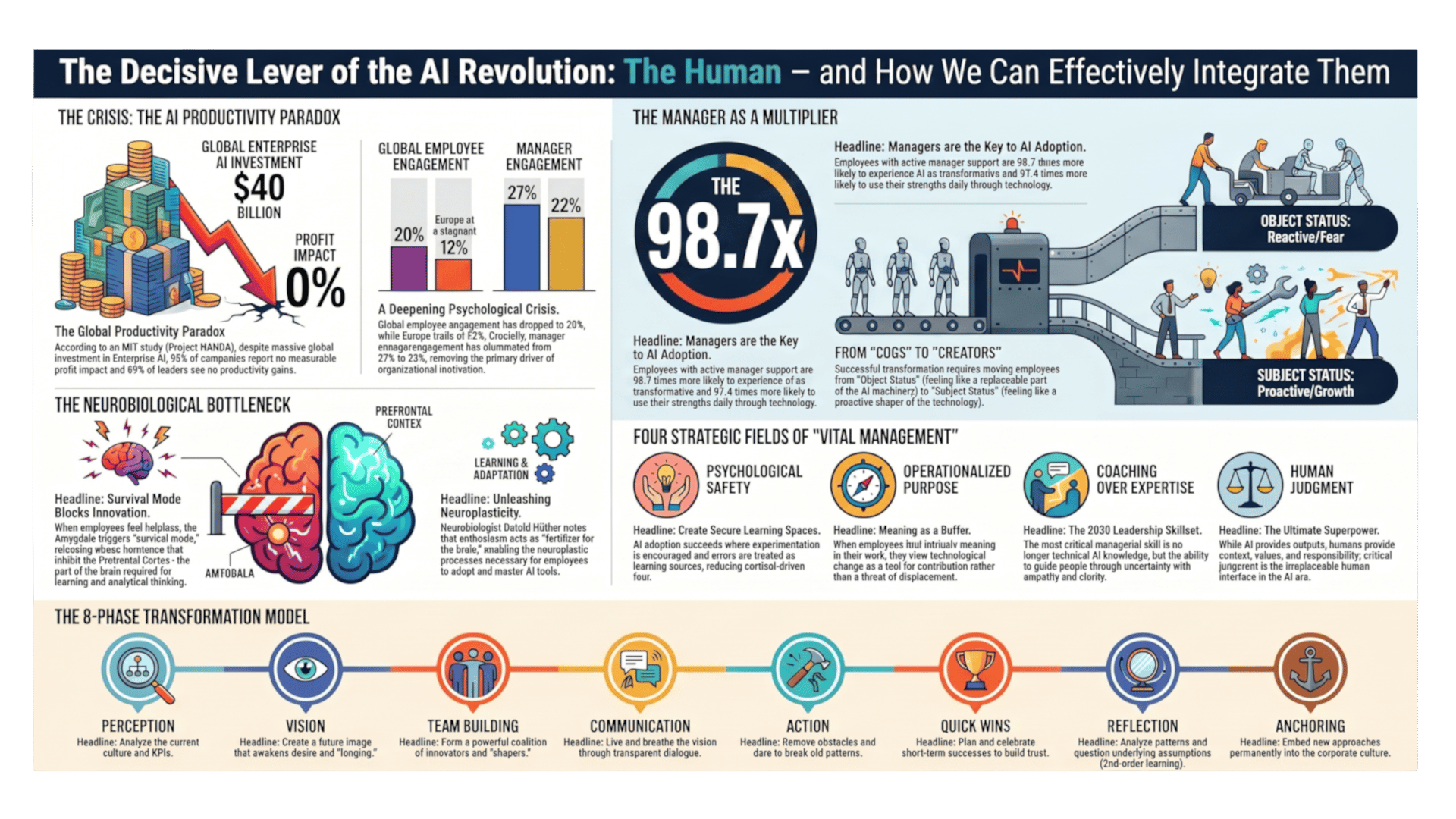
We are witnessing an economic paradox in 2026 that is historic in its dimensions. While companies worldwide are investing record sums of approximately $40 billion into enterprise AI, the hoped-for productivity surge remains elusive. As the current Gallup report "State of the Global Workplace" highlights, global employee engagement has dropped to a historic low of 20%. The result is sobering: According to a recent MIT study (Project NANDA), 95% of companies have so far seen no measurable impact of AI on their profits.
As a discerning observer, I note that we are currently trying to build a state-of-the-art technological bridge on an unstable psychological foundation. We are investing in algorithms while the human base erodes.
The Neurobiological Bottleneck: Why the Brain Blocks AI
Why is productivity not taking hold, even though the tools work? The answer lies not in the software, but in our biology. Neurobiologist Gerald Hüther concludes that human development and creative learning only occur where we meet each other as subjects. We must refuse to instrumentalize each other as mere resources — and start leading people as subjects, not assets.
When organizations decree AI transformations top-down without involving the creative power of their employees, the human brain reacts with an ancient survival mechanism. As Gerald Hüther describes in his analyses, when helplessness is perceived, the prefrontal cortex is inhibited by stress hormones. The amygdala takes control. In this "survival mode," the brain is biologically simply incapable of performing the creative and analytical learning processes that are mandatory for successful AI adoption.
Human enthusiasm, which Hüther calls "fertilizer for the brain," is missing. Instead, particularly in Europe, according to Gallup, engagement remains stagnant at only 12%, reflecting a state of "inner resignation". The brain switches to energy-saving mode to protect psychological integrity instead of unfolding the potential of new technology.
Leadership at the Limit: The Vanishing Manager Premium Engagement
The situation is particularly alarming at the leadership level. For a long time, managers enjoyed an a high engagement level, they were more motivated than their teams. However, the 2026 Gallup data shows a dramatic collapse: manager engagement fell massively to 22% within a single year. Today, leaders suffer measurably more from stress, anger, and loneliness than the people they are supposed to lead.
Yet, this is exactly where the decisive lever lies. According to Gallup, the direct manager is the strongest predictor of the success of AI transformation. The numbers speak a clear language: If a leader actively supports their team in using AI, the probability that employees experience AI as truly transformative for their work increases by a factor of 98.7.
If we rationalise away middle management—a trend the Hidden Champions Trend Report criticizes as "Organizational Flattening"—we destroy the only bridge over which transformation is even possible.
The Seven Greatest Learning Barriers in Modern Organizations
In my work on "Vital Corporate Leadership," supported by the research of Peter Senge and Chris Argyris, I have analyzed the barriers that hinder organizational learning. AI tools cannot solve these obstacles; they often even amplify them if leadership does not consciously counteract them:
- I am my position: Employees define themselves by their tasks. If AI takes over these tasks, an identity crisis arises instead of openness to something new.
- The enemy out there: Blaming technology or the market prevents self-reflection.
- The illusion of learning from experience: In complex systems, we often fail to recognize the delayed consequences of our decisions — AI accelerates this dynamic and makes cause and effect increasingly invisible.
- Fixation on events: We react to short-term AI hypes instead of building long-term structures (Customer Relationship, Strategy, Team, Processes, Finance).
- The myth of the management team: Teams often protect their mental models instead of questioning them in shared dialogue — in the face of an increasingly AI-shaped reality.
- The fear of losing face: In an uncertain world, leaders are reluctant to admit they are still learners themselves.
- Defense routines: We develop clever tactics to avoid real learning because it means pain and uncertainty.
The Thesis: Emotionality Beats Algorithms
- Create psychologically safe learning spaces: AI is successfully adopted where experimentation is explicitly desired. When errors are treated as a source of learning, cortisol-driven fear decreases, and space for neuroplastic processes opens up.
- Operationalize purpose—do not just decorate it: Meaning is not a motivational poster. Employees must experience the difference their work makes for others. Those who feel a sense of purpose fear technological change less and help shape it more actively.
- Coaching competence over technical expertise: The most important skill of a leader in 2030 is not knowledge of neural networks. It is the ability to accompany people through uncertainty—with empathy, clarity, and mindset.
- Judgment as a human superpower: AI provides outputs but no context, no values, and no responsibility. This human interface—the ability to critically evaluate AI results—becomes the most important core competency in top management, as Dr. Burkhard von Spreckelsen emphasizes in the current Hidden Champions Report.
- Action: Removing obstacles and daring the necessary break of pattern.
- Quick Wins: Plan short-term successes and celebrate them visibly — to build trust in the process and sustain the team's energy and momentum.
- Reflection: Analyzing achieved solutions for patterns – Level 2 Learning: Questioning the assumptions, values, and mental models behind a specific behavior. "Why do we even do it this way? Is our basic assumption still correct?"
- Anchoring: Codifying and establishing new approaches in the corporate culture.
Conclusion: The Decision Lies with the Mindset
The AI revolution is not won in the data center. It is won or lost in the moment a leader speaks with an employee. In the moment when uncertainty is either absorbed or reinforced.
As the Hidden Champions Trend Report shows, there are two opposing strategies: Large corporations often use AI primarily to reduce headcount. Smaller, more agile companies use it as a growth engine. This is not a technological decision but a question of mindset.
Proven management approaches exist that lead teams to lasting success and organizational vitality. The AI era doesn't just need managing — it needs shaping.
I offer concrete ways to bring these approaches into your organization.
Let's connect and work on your business vitality system.
Dirk Kowalewski
Vital Corporate Leadership - Broad in vision. Clear in goal. Concrete in implementation.
Sources:
- Gallup: State of the Global Workplace 2026 Report – The Human Side of the AI Revolution.
https://www.gallup.com/workplace/349484/state-of-the-global-workplace.aspx - Gerald Hüther: Neurobiological analyses on leadership, transformation, and collective helplessness. Various videos.
https://www.youtube.com/@GeraldHuether-original - Dirk Kowalewski: The Vital Company – Paths to Effective and Sustainable Cooperation (Master's Thesis & Consulting Concept).
https://www.amazon.de/Das-vitale-Unternehmen-nachhaltigen-Zusammenarbeit/dp/394067754X - Hidden Champions Trend Report 2026: Artificial Intelligence in Medium-Sized Businesses (Issue 2).
https://www.hidden-champions-trendreport.de/?utm_source=chatgpt.com